A google sketchup model of the new terminal created by me is pasted here. Type Chennai terminal and you will get it. It can also be viewed in Google Earth by zooming to the place.
Monday, December 22, 2008
Chennai Airport expansion project
Work on the Rs. 2000 crore Chennai Airport expansion project has finally got off with the handover 130acres of land to the AAI. The land will be used for extending the secondary runway beyond the Adyar river. The project involves construction of a new Domestic Terminal, expansion of the International terminal, sprucing up the Cargo terminal and extension of the secondary runway. The new domestic terminal has been designed by a consortium of 4 firms including Hargreaves Associates, Frederic Schwartz firm and The Creative Group. The terminal has been designed to handle a capacity of 10 million passengers per annum. Hope the project will be finished in time to witness growth after the current economic slowdown that has led to a decrease in air travellers. Full news about the project can be read from the following link.

Friday, December 5, 2008
Political pressure or Corporate Ethics
After more than half a decade of extravagant growth, the aviation sector is yielding to the World Economic Crisis. Suddenly the word 'pink slips' has become common. It was a matter of over capacity. The sky-rocketing oil prices added fuel to the fire. The American aviation sector saw huge amount of capacity cutting including retirement of some old workhorses from their fleet which weren't efficient. Older pilots got their retirement early.
In the Indian sector those carriers which were operating daily services to tier-2 and tier-3 cities started cutting their capacity even on the inter metro sectors. The two Private giants Kingfisher and Jet Airways who were on an international expansion mode put on hold, their plans as well as new contracts. But the term 'pink slips' never entered the Indian aviation sector. Except for a handful of old international pilots who were sacked(that was also following a DGCA notification on air safety) and the unsuccessful layoff drama by Jet, Indian aviation didn't see much.
Jet's layoff and the immediate backtracking by its chairman brings up to the table a long pending question that hasn't been answered yet. In case of a crisis situation, how will the Indian Corporate sector react? This is the first time that the private sector is facing such a deep crisis in our country. Before 1991, government policies insulated the bottom half of the employee pyramid from any such problems. But now, the private players, they have to decide upon the future of the company and its employees. Jet Airways followed the west's method but came under severe pressure from local political parties for it, and the concept of employees union entered the arena. Kingfisher and Air India were cautious enough to not take such drastic steps.
The corporate culture and ethics in India is quite different from the rest of the world. The Tatas and the Birlas stand as living example of what it is. The Indian players will be up against those who are ready to take desperate measures to see that their stocks remain in the green throughout the year. Back home the playing field is different. Other things like social responsibility, Employees welfare etc assume larger significance.
India is fast emerging as a super power in the region. Now its decisions will not only affect the Domestic industrial sector, but also to some extent, the region as a whole. Every move made by it will be watched from outside. With the private sector having a larger role to play, they must realize their responsibility. The next few years will be a testing time for it. How it deals with the crisis is going to determine its role and value, in India as well as in the global arena.
Saturday, December 8, 2007
Infrastructure bottlenecks
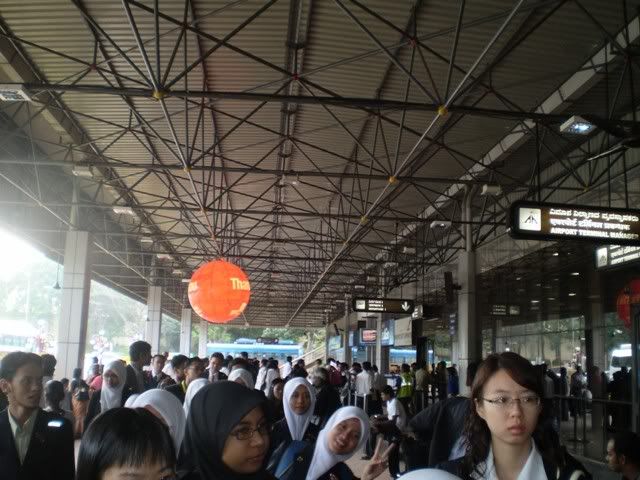

While the Indian aviation sector continues to boom, the state of infrastructure of airports across the country is appalling. Long queues in check-in counters, customs, immigration and poor parking and access facilities present a dismal picture. On the air-side lack of adequate parking bays, inefficient ground handling facilities and long time for landing and take-off of aeroplanes are costing the companies dear. The pictures show the situation at various airports.
The first picture shows the situation on the taxiway of Mumbai Int'l airport. The modernisation drive being carried out at the airport is expected to decongest the airport and also be able to enhance its handling capacity. Modernisation of other metro's airports are under various stages of implementation. As for Bengaluru(Banglore) and Hyderabad they are getting new greenfield airports by next year. The state of the present airport is in the first picture.Sunday, July 1, 2007
Airbus A-380 is not the largest!!!


It would fascinate the reader to know that the Airbus A- 380 is not the largest of aircrafts presently. Very few people know about the Airbus Beluga and the Boeing Dreamcarrier which are actually more than 1.3 times the size of an A-380. It is mainly a transporter(used only for cargo puposes). The second picture is of a Beluga unloading a fuselage.
For example, Airbus is a consortium formed by a group of European nations. So the manufacture and the profits thus gained are shared among the countries. Hence, different parts of an aircraft are made in different countries and is finally moved to its Toulouse assembly plant, where the parts are assembled. In such cases these carriers are used to transport the fuselage and wings, which are bigger. It is for these purposes that a transporter is used.
If an Airbus Beluga could carry the fuselage(the central tube like part of an aircraft) of an Airbus A-380 consider its size. There are totally a five of them under operation eith Airbus and an equal number with Boeing. These days they also leased to other companies to transport combat aircrafts, helicopters, space station components and large machinery. If converted to a passenger aircraft(which has not yet been done) it can accomodate between 1800 to 2000 passengers over four floors(a nice substitute for trains).
For example, Airbus is a consortium formed by a group of European nations. So the manufacture and the profits thus gained are shared among the countries. Hence, different parts of an aircraft are made in different countries and is finally moved to its Toulouse assembly plant, where the parts are assembled. In such cases these carriers are used to transport the fuselage and wings, which are bigger. It is for these purposes that a transporter is used.
If an Airbus Beluga could carry the fuselage(the central tube like part of an aircraft) of an Airbus A-380 consider its size. There are totally a five of them under operation eith Airbus and an equal number with Boeing. These days they also leased to other companies to transport combat aircrafts, helicopters, space station components and large machinery. If converted to a passenger aircraft(which has not yet been done) it can accomodate between 1800 to 2000 passengers over four floors(a nice substitute for trains).
Consolidation all the way
Industry sources state that the public can expect another merger. There are indications that Paramount Airways (which mainly caters to the southern region) is looking at Go Air (for picking up stake) to extend its presence in the western and northern region.
I'll keep the viewer updated on the Indian aviation sector from time to time and make a move from the economic sector to the technical sector.
I'll keep the viewer updated on the Indian aviation sector from time to time and make a move from the economic sector to the technical sector.
Sunday, June 3, 2007
Another merger!!!!!!!!!!!!!!!!!!!!!!!!!!
In my last post, it was stated that the Indian aviation industry was undergoing a phase of consolidation with announcements of major acquisitions and mergers. Well, it seems that this would continue. The recent announcement of taking 26% stake in Air Deccan by UB Holdings Chairman Mr. Vijay Mallya (better known as the liquor baron of India) has set alarm bells ringing among the other Indian players. It is seen as a strategic move by both the airlines, as they could share their infrastructure and ideas, play better in such a highly competitive sector and cut down costs on operation and business. This is not the end of the fairy tale of consolidation, as another player has already announced similar intentions. These would go a long way in the development and maturity of the sector.
Let us hope that the low cost carriers don't move away from the scene too early. It was because of them that the aviation sector has developed to this extent and I can fly to Bangalore and be back with a mere 500 bucks even today.
Let us hope that the low cost carriers don't move away from the scene too early. It was because of them that the aviation sector has developed to this extent and I can fly to Bangalore and be back with a mere 500 bucks even today.
Sunday, May 27, 2007
THE BIG FIGHT MOVES TO INDIA
The age old fight between the Airbus industrie and Boeing.Co seems to be a never ending one with the new battle field taking shape int the form of India. With the Open sky policy, the Indian aviation industry has seen a boom in the recent past(needless to say, unmatched by a stagnant physical infrastructure). The years 2003 and 2004 saw the emergence of many new low cost carriers. Though some of them still run on leased aircraft the market for planes grew tremendously.It all started with the state owned Air India entering into an agreement with Boeing to buy 50 and odd aeroplanes from the latter.
When Indigo airlines stated in a press release that it is going to buy 100 A-320s(a huge chunk) , Airbus realised that India is no more a penny market but has the potential to be its no. 1 market and soon started exploring the possibilities of setting up MRO(maintenance repair and overhaul)facilities in the country to attract more buyers. Kingfisher Airline's decision to buy 5 Airbus A-380s(the super jumbo) only came as a confirmation to the Airbus's idea. The end of 2005 saw the emergence of Jet Airways as a good player in the private sector which gave them the confidence to invest in a few birds from the Boeing.Co to extend its services to the gulf and the south east asian nations.
The year 2006 was a period of consolidation for the aviation industy seeing mergers, buyouts and public issues . The busy stalls of the Airbus and Boeing at the Aero India show clearly shows the intentions of the two rivals. But would the poor infrastructure at airports be able to keep up with the pace with which the industry is growing? With the cost of air turbine fuel increasing by the day, would the low cost carriers be able to sustain themselves in this highly competitive market? Well. The answers to these questions is definitely going to determine the future moves of the two airline manufacturers.
Well, anything happens in the future or not, currently a flight ticket to New Delhi seems to be far more cheaper than an AC train ticket. So live the present and enjoy as long as it is available to you(m not talking abt the 1Re tickets, surely not).
When Indigo airlines stated in a press release that it is going to buy 100 A-320s(a huge chunk) , Airbus realised that India is no more a penny market but has the potential to be its no. 1 market and soon started exploring the possibilities of setting up MRO(maintenance repair and overhaul)facilities in the country to attract more buyers. Kingfisher Airline's decision to buy 5 Airbus A-380s(the super jumbo) only came as a confirmation to the Airbus's idea. The end of 2005 saw the emergence of Jet Airways as a good player in the private sector which gave them the confidence to invest in a few birds from the Boeing.Co to extend its services to the gulf and the south east asian nations.
The year 2006 was a period of consolidation for the aviation industy seeing mergers, buyouts and public issues . The busy stalls of the Airbus and Boeing at the Aero India show clearly shows the intentions of the two rivals. But would the poor infrastructure at airports be able to keep up with the pace with which the industry is growing? With the cost of air turbine fuel increasing by the day, would the low cost carriers be able to sustain themselves in this highly competitive market? Well. The answers to these questions is definitely going to determine the future moves of the two airline manufacturers.
Well, anything happens in the future or not, currently a flight ticket to New Delhi seems to be far more cheaper than an AC train ticket. So live the present and enjoy as long as it is available to you(m not talking abt the 1Re tickets, surely not).
Subscribe to:
Posts (Atom)